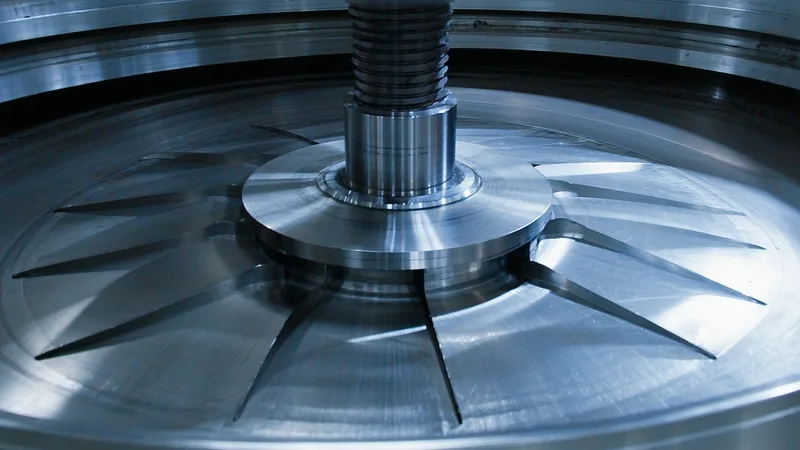
Impeller selection is one of the few vessel design decisions that directly determines whether your fermentation process can achieve its target titer at scale. It affects kLa, mixing time, shear stress on cells, power consumption, and the spatial distribution of dissolved oxygen and substrate — all of which change substantially between 500L and 10,000L. Yet impeller decisions are often treated as vendor defaults rather than process-specific engineering choices.
This article covers the three most common impeller configurations for aerobic fermentation scale-up: the Rushton turbine, the pitched-blade turbine (PBT), and the hydrofoil (A315 or similar). Each has specific advantages and limitations that determine when it's the appropriate choice.
The Rushton Turbine
The Rushton turbine (flat-blade disc turbine, DT6) is the standard reference impeller for aerobic fermentation. It is a radial-flow impeller that generates a horizontal discharge pattern from the impeller tips, creating two toroidal circulation loops (one above, one below the impeller) in a standard baffled vessel.
Oxygen transfer performance
The Rushton turbine is a high-kLa impeller for its power input — it disperses sparged gas effectively through the high-turbulence zone near the impeller tips, creating small bubbles with high surface area for oxygen transfer. The kLa correlation for a Rushton turbine in a standard configuration (D/T = 0.33, C/T = 0.33, baffled vessel) is typically expressed as:
kLa = A × (P/V)^α × v_s^βwhere P/V is the specific power input (kW/m³), v_s is the superficial gas velocity (m/s), and the constants A, α, β are empirically determined for the vessel geometry. For a Rushton configuration, typical values are α ≈ 0.4–0.6 and β ≈ 0.5–0.6, giving kLa values of 150–400 h⁻¹ at P/V of 1–4 kW/m³ in water.
At commercial scale (10,000L+), maintaining the same P/V as at pilot scale requires a proportionally higher absolute power input, which is both energy-expensive and mechanically demanding (larger motor, stronger shaft). This is one reason that commercial-scale fermentation often operates at lower P/V (0.5–1.5 kW/m³) than pilot scale (1–4 kW/m³), with a corresponding kLa reduction.
Mixing time
The Rushton turbine's radial discharge pattern is efficient at local mixing near the impeller but less efficient at bulk axial mixing throughout the vessel height. In a tall vessel (H/D > 1.5), a single Rushton impeller creates well-mixed zones above and below the impeller with a poorly mixed transition zone between them. Multiple Rushton impellers stacked vertically (2–4 impellers for H/D = 2–3 vessels) improve axial mixing but increase mechanical complexity and power consumption.
Mixing time for a single Rushton turbine scales approximately as:
t_m ∝ (D²/N)^(1/3) × (T/D)^αAt 500L with a typical impeller diameter of 0.4m and N = 200 rpm, mixing time is approximately 90–150 seconds. At 10,000L with D = 1.0m and N = 70 rpm (maintaining similar tip speed), mixing time extends to 200–350 seconds — a 2–3× increase that has significant implications for substrate gradient formation in fed-batch operations.
Shear sensitivity
The Rushton turbine generates high local shear near the impeller tips, which is effective for gas dispersion but potentially damaging for shear-sensitive organisms. For mycoprotein (F. venenatum) fermentation, excessive tip speed (>3.5–4 m/s) can physically damage the hyphal network, affecting product texture. For mammalian cell fermentation (not common in alt-protein but relevant for precision dairy proteins produced in cell culture), Rushton turbines are typically replaced with gentler impellers. For bacterial fermentation (E. coli), shear sensitivity is not typically a concern at standard operating tip speeds.
The Pitched-Blade Turbine (PBT)
The pitched-blade turbine uses angled blades (typically 45° pitch) that generate primarily axial flow, pumping the culture either upward or downward through the vessel. This fundamentally different flow pattern has significant implications for mixing and oxygen transfer compared to the Rushton turbine.
Oxygen transfer performance
The PBT is a less effective gas disperser than the Rushton turbine at the same P/V. Its kLa at equivalent specific power is typically 20–40% lower than a Rushton turbine in the same vessel. The reason is that radial flow is more effective at breaking up gas bubbles and creating the high turbulence necessary for oxygen transfer, while axial flow is primarily useful for bulk mixing.
However, PBT's kLa can approach Rushton performance when the impeller is operated at higher power input to compensate, and in processes where mixing-time heterogeneity is the primary scale-up challenge (rather than bulk kLa), the PBT's superior bulk mixing efficiency makes it the better choice overall — even at slightly lower kLa per unit power.
Mixing performance
The PBT's axial flow pattern generates much better bulk mixing than the Rushton turbine, particularly in tall vessels. A single downward-pumping PBT in a vessel with H/D = 2.0 can achieve mixing times 40–60% shorter than a single Rushton turbine at the same P/V. For tall commercial-scale vessels where the Rushton turbine would require 3–4 stacked impellers to achieve adequate bulk mixing, a 2-impeller PBT configuration may give equivalent mixing with lower mechanical complexity.
Application guidance
PBT is typically preferred when: the process has a shear-sensitive organism or product; the vessel has a high H/D ratio (>2.0) and axial bulk mixing is the primary concern; the kLa requirement can be met at slightly lower gas dispersion efficiency; or the process benefits from uniform substrate distribution more than from high local kLa near the impeller.
Hydrofoil Impellers (A315, Lightnin A310, Ekato Intermig)
Hydrofoil impellers use aerodynamically shaped blades that generate axial flow with very low drag, achieving high flow rates per unit power input. They are more expensive to manufacture than standard flat-blade or pitched-blade impellers but offer the best bulk mixing efficiency per unit energy of any standard impeller type.
Oxygen transfer performance
Hydrofoil kLa performance is typically 30–50% below Rushton performance at the same P/V — the lowest gas dispersion efficiency of the three types discussed here. Hydrofoils are rarely used as the primary impeller in high-OUR aerobic fermentation unless supplemental oxygen enrichment is available, because maintaining the required DO setpoint would require prohibitively high P/V for a high-density bacterial or fungal process.
However, in dual-impeller configurations — typically a Rushton turbine as the bottom impeller (for gas dispersion) and a hydrofoil as the upper impeller (for bulk mixing) — hydrofoils are increasingly common in commercial-scale fermentation where the high H/D ratio requires both efficient gas dispersion at the sparger level and efficient bulk mixing throughout the vessel.
Shear sensitivity and cell viability
Hydrofoils generate very low local shear, making them the preferred choice for shear-sensitive organisms. In mycoprotein fermentation where hyphal morphology is quality-critical, a Rushton + hydrofoil combination provides gas dispersion from the Rushton and low-shear bulk mixing from the hydrofoil. The Rushton handles the kLa requirement; the hydrofoil handles the mixing time requirement without imposing damaging shear on the culture.
Scale-Up Impeller Selection: A Decision Framework
When selecting impellers for a new pilot or commercial vessel, or when evaluating a contract manufacturer's standard vessel for fit with your process, apply the following hierarchy:
- Calculate the required kLa. From your FBA-predicted OUR demand at peak density and your target DO setpoint, calculate kLa_min = OUR_peak / (DO* × (1 − DO_setpoint/100)). This sets the floor for impeller performance.
- Assess organism shear sensitivity. If shear sensitivity is a concern, PBT or Rushton + hydrofoil is preferred over pure Rushton at high tip speeds. For E. coli, shear sensitivity is not typically limiting below tip speeds of 5–6 m/s.
- Calculate expected mixing time at target operating conditions. Using the impeller correlation for your vessel geometry and target N (rpm), estimate tm. Compare to your maximum acceptable substrate gradient time (typically <1/3 of the process fluctuation timescale for fed-batch).
- Calculate P/V at the target N. From P/V and kLa correlation, estimate the expected kLa. Compare to kLa_min from step 1. Adjust N or impeller configuration until the requirement is met within motor capacity constraints.
- Check tip speed at the target N. Tip speed = π × D × N. If tip speed exceeds the organism's tolerance threshold, reduce N and compensate by increasing aeration rate or oxygen enrichment.
What Changes Between 500L and 10,000L
The critical difference between 500L pilot and 10,000L commercial scale for impeller selection is not just scale — it's the operating regime. At 500L, achieving kLa of 150–250 h⁻¹ with a single Rushton turbine at 1.5–3 kW/m³ is standard. At 10,000L, achieving kLa of 80–150 h⁻¹ at 0.5–1.5 kW/m³ is typical — a meaningful kLa reduction that must be accounted for in your DO supply calculation.
If your process was developed at 500L with a kLa of 200 h⁻¹ and you assume similar performance at 10,000L, you will likely be wrong by 40–60%. The commercial vessel will need either oxygen enrichment, a different impeller configuration, or a process redesign (reduced target cell density or growth rate) to match the DO supply that was available at pilot scale.
References
- Nienow AW. Hydrodynamics of stirred bioreactors. Appl Mech Rev. 1998;51(1):3–32.
- Garcia-Ochoa F, Gomez E. Bioreactor scale-up and oxygen transfer rate in microbial processes. Biotechnol Adv. 2009;27(2):153–176.
- Doran PM. Bioprocess Engineering Principles. 2nd ed. Academic Press; 2013. Chapter 8.
- Noorman H. An industrial perspective on bioreactor scale-down. Biotechnol J. 2011;6(8):934–943.